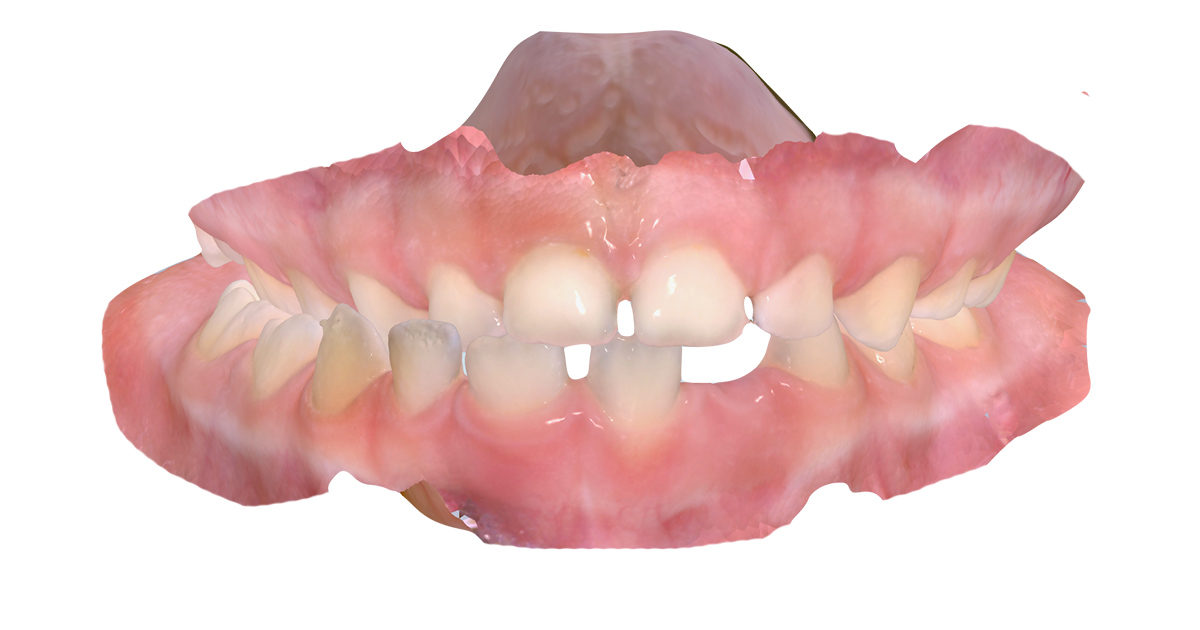
A crossbite means your child's teeth do not line up the way they should. Why it matters for the jaw and airway, and why fixing it early is far simpler.
By Dr. Courtney Lavigne, DMD, Board-Certified Orthodontist
March 17, 2026
If your child's dentist has mentioned a crossbite (or you've noticed that their upper and lower teeth don't seem to line up quite right) you're probably wondering how serious it is and what to do about it. Here's a plain-language explanation.
What Is a Crossbite?
A crossbite happens when one or more upper teeth bite on the inside of the lower teeth rather than on the outside. It can happen in the front of the mouth (anterior crossbite) or in the back (posterior crossbite), and it can affect one tooth or several.
In a normal bite, the upper teeth sit slightly outside the lower teeth all the way around, like a lid on a box. In a crossbite, part of that relationship is reversed. The upper and lower jaws aren't lining up the way they're supposed to.
Why Does It Happen?
Crossbites are usually skeletal, meaning the upper jaw is developing too narrowly relative to the lower jaw. This can be influenced by genetics, habits like prolonged thumb sucking or pacifier use, prolonged mouth breathing, or simply the way a child's teeth erupt. In many cases there's no single identifiable cause. It's just how the jaw grew.
Why Does It Matter?
A crossbite isn't just a cosmetic issue. Left untreated, it can cause real problems:
- Jaw shifting. When a child bites down and their teeth don't meet properly, the jaw often shifts to one side to find a comfortable position. Over time, this can cause asymmetric jaw development, with one side of the face growing differently from the other.
- Uneven tooth wear. Teeth in crossbite absorb forces they weren't designed for, wearing down enamel prematurely.
- Jaw joint strain. Chronic misalignment can put uneven stress on the jaw joints over time.
- Airway impact. A narrow upper arch, which is often what's causing the crossbite, also reduces the space inside the nasal cavity. Addressing the crossbite with palate expansion can improve nasal breathing at the same time. This connection is the heart of airway-focused orthodontics.
When Should It Be Treated?
This is where timing really matters. Crossbites are one of the clearest cases where earlier treatment is better, not because we're in a rush, but because the tools available for a young child are far simpler than what's needed in the teenage years or adulthood.
In a young child, a crossbite caused by a narrow upper arch can often be corrected with a palate expander. The two bones of the upper palate haven't fused yet, so gentle steady pressure can widen the arch, correcting the crossbite, creating room for adult teeth, and improving the airway all at once.
In a teenager, the same correction is harder. The bones have started to intertwine. More force is required, and results are less predictable. And in an adult, non-surgical correction of a skeletal crossbite often isn't possible at all, so jaw surgery may be the only option.
A child who gets a crossbite treated early with a simple expander and early intervention is in a very different position than that same child years later facing surgical jaw correction.
What Does Treatment Look Like?
For most children with a posterior crossbite, treatment starts with a palate expander to widen the upper arch. At Anchor Orthodontics, we use custom 3D-printed expanders made to a precise model of your child's mouth, with no uncomfortable metal bands and no goopy impressions. Cementing the expander in doesn't hurt, and most kids are eating normally within a few days.
After expansion, some children need Phase 2 braces or aligners to fine-tune alignment once all the adult teeth are in. But that process is shorter and simpler when the foundation has been correctly laid first.
When Should My Child Be Evaluated?
The American Association of Orthodontists recommends a first orthodontic evaluation by age seven, and crossbites are one of the main reasons why. You don't need to wait for your dentist to refer you. If you've noticed that your child's teeth don't meet symmetrically, or if their jaw seems to shift when they bite down, an evaluation is worth scheduling now.
At Anchor Orthodontics in Providence and Wakefield, we'll look at what's happening, explain what we see in plain language, and tell you whether there's a window worth using or whether monitoring is the right approach.
Book an evaluation at our Providence or Wakefield office →