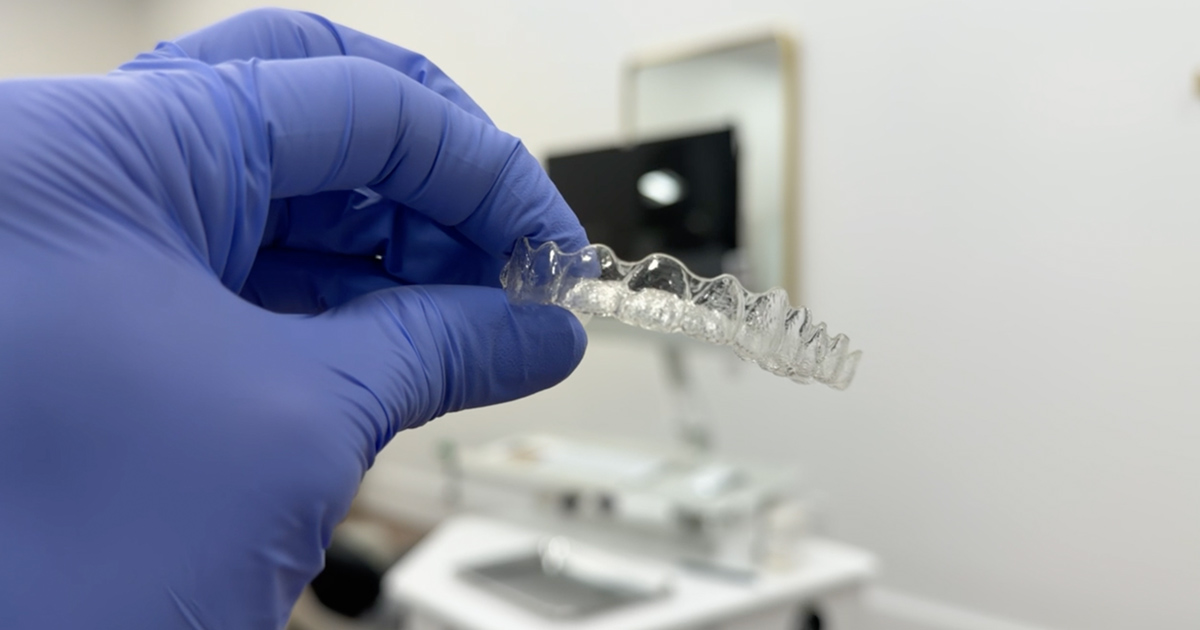
Is Invisalign right for your child? How clear aligners actually work, when they make sense for kids, and what Providence and Wakefield parents should know.
By Dr. Courtney Lavigne, DMD, Board-Certified Orthodontist
March 25, 2026
First, let's clear something up about Invisalign
A lot of parents come in asking specifically for Invisalign. I understand why — it's the most recognized name in clear aligners. But I like to explain it this way: Invisalign is to clear aligners what Kleenex is to tissues. Kleenex is a brand of tissue. Invisalign is a brand of clear aligner — admittedly the largest and most well known, but one of many.
At Anchor Orthodontics, we work with Invisalign and with other clear aligner brands. We choose the brand for each patient based on which one can achieve our desired results most efficiently and most effectively. The aligners are simply the tool that executes the prescription — and the prescription is written by the orthodontist responsible for the outcome. That's where the real work happens.
How clear aligners actually work
Clear aligners work by placing pressure in predetermined areas to rotate, torque, and reposition teeth. Where braces pull on teeth through their interaction with the wire, aligners are pushing. Each set of trays is worn for about a week before advancing to the next.
One thing that surprises parents: the number of trays isn't always what you'd expect based on how the teeth look. Sometimes a case that looks very complicated can be finished in a relatively small number of trays because the movements are easy to accomplish. On the contrary, sometimes teeth look pretty straight at the start, but the required movements are harder to achieve and we end up with more trays to get to the finish line. Complexity isn't always visible on the surface.
At our Providence and Wakefield locations, we see patients every 8 to 12 weeks during treatment. We send patients home with enough trays to get to the next appointment — so there's no coming in every week.
The non-negotiable: 22 hours a day
Clear aligners need to be worn to work. Our goal is 22 hours out of every 24. That means they're in full time other than eating or drinking anything other than water. This is the biggest factor in whether a child is a good candidate for aligner treatment — not the complexity of the case, but the compliance.
A motivated, responsible kid can absolutely do this. A child who tends to lose things or forget commitments is going to have a harder time, and we'd rather be honest about that upfront than end up with treatment that drags or doesn't finish where we planned. If compliance is a real concern, we'll talk about it at the consultation.
When clear aligners make sense for kids
Aligners work well for children with mild to moderate crowding, spacing, or certain bite issues who are mature enough to manage the responsibility. Invisalign also makes a product called Invisalign First specifically designed for younger kids who still have a mix of baby and permanent teeth — it can address some jaw development concerns, not just tooth position.
That said, my background shapes how I approach every case. I focus first on airway and breathing health, then on growth modification in our younger patients, and then on dental and facial aesthetics. If a child has underlying airway or jaw development issues, those need to be part of the plan — and aligners alone may not be the right tool for that work.
When braces are the better call
For kids with more significant bite problems, skeletal issues, or complex tooth movements, braces give us more precise control and more predictable results. At both our Providence and Wakefield offices, we use LightForce brackets — custom 3D-printed to each patient's individual tooth shape — so even traditional braces are more comfortable and efficient than what most parents remember from their own childhood.
For younger patients in Phase 1 treatment, expanders and other appliances are often part of the plan, and those work alongside braces more naturally than aligners in most cases.
What to expect at a consultation
We don't walk into a consultation with a predetermined answer. We take 3D records, evaluate how the teeth and jaws are developing, and have a direct conversation about what will get your child the best result — and why. We also don't believe every child needs treatment early, but we do believe every child should be evaluated by age 7. Not because we're going to treat them at 7, but because early evaluation lets us catch the things that are easiest to address before growth windows close.
If clear aligners are the right fit for your child, we'll tell you. If braces will serve them better, we'll tell you that too.
A few questions we hear often
Does Invisalign cost more than braces? In our practice, the cost is comparable. What affects price is the complexity of the case and the length of treatment — not which appliance we use.
Can aligners fix my child's bite, not just their teeth? To a degree, yes. Clear aligner technology has improved significantly. But there are limits, and for more significant skeletal or jaw issues, braces combined with other appliances usually give us better outcomes.
What if my child is already in Phase 1? Invisalign First is designed for mixed-dentition kids. Whether it's appropriate depends on what the records show. Many Phase 1 cases still benefit from traditional appliances — we'll know more once we've evaluated your child.
What about whitening? We recommend whitening after treatment is complete and attachments are removed. Whitening during treatment can cause uneven results around the attachment sites. After treatment is the right time to brighten a now-straight smile.
Come see us in Providence or Wakefield
Anchor Orthodontics has two Rhode Island locations — 133 Pitman St on the East Side of Providence, and 24 Salt Pond Rd in Wakefield. Dr. Courtney Lavigne and Dr. Lauren Cardarelli see patients Monday through Thursday. Call us at (401) 782-1221 or book online at anchororthodontics.com/booking.